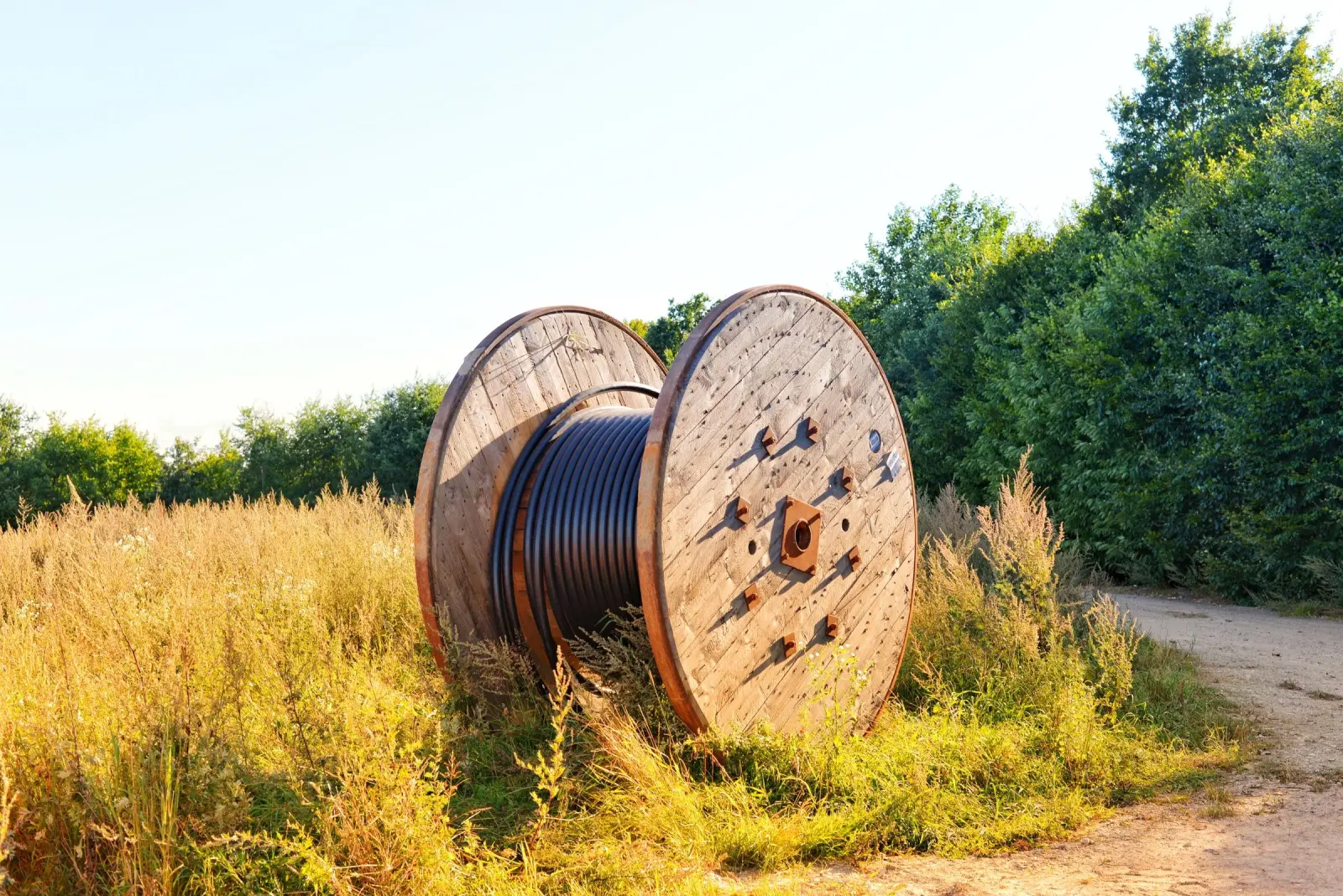
We tend to think of the internet as placeless, but data actually travels through fiber-optic cables laid on the seabed and buried under roads. Those cables have a geography: distance, corridors and chokepoints decide how fast data arrives and how exposed it is to outages. That is why Syria's strategic location keeps coming up as the basis for an overland data corridor linking the Mediterranean with the Gulf.
The Red Sea: a crowded corridor and a single point of failure
A large share of the data moving between Europe and Asia follows closely spaced subsea routes through Egypt and the Red Sea. Two figures are often quoted, and they measure different things:
- Communications Minister Abdulsalam Haykal told Oxford Business Group that about 17% of global traffic passes through the Red Sea, which he called "a single point of failure".
- Fortune, citing the Center for Strategic and International Studies (CSIS), reports that more than 90% of Europe-Asia data and telecom traffic flows through Egypt and the subsea corridors converging at the Red Sea and Suez.
The first figure covers all global traffic; the second covers traffic between two continents. They do not contradict each other, and together they make the same point: heavy dependence on one corridor.
That dependence became visible on 6 September 2025, when failures in the SMW4 and IMEWE cables near Jeddah degraded connectivity in Saudi Arabia, the UAE, Pakistan and India and raised latency on Microsoft Azure, as Al Jazeera reported.
The Syria data corridor as proposed
SilkLink rests on a simple idea: data arriving from Europe across the Mediterranean lands on the Syrian coast and then travels overland toward the Gulf. Al Majalla describes the project as turning Syria, Jordan and Saudi Arabia into a cable corridor, with Syria as the entry point from Europe and the Gulf as the exit toward Asia. The plan includes a landing station at Tartous and connection points with Iraq, Jordan, Lebanon and Turkey.
In his interview with Oxford Business Group, Haykal said that combining a Mediterranean landing with an overland route through Jordan into Saudi Arabia could shorten Gulf-Europe routes by about 6,000 km and save 30-35 milliseconds of latency. That margin matters for cloud computing, financial trading and interactive applications.
The idea has attracted real interest. Semafor reported that five bidders competed for the project and that the route would let Gulf-Europe data bypass the Red Sea. And when the minister met the ITU Secretary-General on 11 November 2026, the ministry described SilkLink as an additional Europe-Asia route through Syria that reduces the risk of traffic concentrating in a few corridors, according to SANA.
An older idea returns
The overland corridor is not a new concept. In 2010, a consortium that included Syria Telecommunications Establishment signed the Regional Cable Network (RCN), a terrestrial route running Fujairah-Riyadh-Amman-Tartous-Istanbul, 7,750 km long with a design capacity of up to 12.8 Tbps, according to Light Reading. Its current status is unknown. What has changed since then is the scale of demand for capacity and a much sharper awareness of the risks of relying on the Red Sea.
The competition: other corridors north of the Gulf
Syria is not the only contender. Regional operators are investing in several overland routes:
- SONIC: a fiber network between Saudi Arabia and Oman being built by stc and Ooredoo Oman, due within 24 months of February 2025, according to Ooredoo Oman; Fortune describes it as a 1,931 km terrestrial corridor.
- WorldLink: a $700 million subsea-and-terrestrial cable announced by an Iraqi-UAE consortium, running from Fujairah to Iraq's Faw peninsula and then overland to the Turkish border, per Khaleej Times (Reuters).
- Ooredoo's route: more than $500 million for a path from Oman through Iraq and Turkey, per Semafor.
These projects show the demand is real. They also show that location alone will not win the traffic: operators will choose the route that is finished first and runs most reliably.
Syria's international connectivity today
Syria currently relies on a small number of subsea cables, according to MEA Tech Watch:
- Aletar to Egypt (1997);
- Berytar to Lebanon (1997);
- Ugarit to Cyprus (1995).
Two new systems are planned at Tartus: Medusa and Ebla (UGARIT 2). These are the gateways whose capacity SilkLink is meant to carry inland and on to neighbouring countries.
What this means for building telecom infrastructure in Syria
Geography is an advantage, but it only becomes value once infrastructure is built on the ground. For a Syrian data corridor to earn operators' trust, it needs:
- fiber routes built to international standards, with documented trenching, cable deployment and splicing;
- route diversity inside the country, so the overland corridor does not become a single point of failure itself;
- protection for terrestrial routes, manholes and landing stations;
- data centers close to transit points, to make use of the capacity passing through.
If you have a project in this field, get in touch.